
Emotional Quotient Skills: The 5 Core EQ Abilities That Define Personal and Professional Success
Why EQ Matters More Than IQ, And How to Build It
Updated: May 2026 | By: Biocybernaut Institute | Sedona, AZ
Emotional quotient (EQ), or emotional intelligence, is the ability to recognize, understand, manage, and effectively express your emotions while perceiving and responding to the emotions of others. The five core emotional quotient skills are self-awareness, self-regulation, motivation, empathy, and social skills. Research shows EQ accounts for up to 58% of professional performance. It is the single strongest predictor of leadership effectiveness, yet unlike IQ, emotional quotient skills can be developed and strengthened at any age. At Biocybernaut Institute, we have spent 40 years and $30 million in research demonstrating that alpha brainwave training accelerates EQ development by retraining the brain at the neurological level producing measurable personality improvements, emotional regulation gains, and anxiety reduction in just 7 days.
This guide explains what emotional quotient skills are, why they matter more than IQ for real-world success, how each skill works, how to develop them through practical methods, and how neurofeedback offers a fundamentally different path to emotional intelligence that traditional approaches cannot match.
What Are Emotional Quotient Skills?
Emotional quotient (EQ) is a measure of your emotional intelligence your capacity to work with emotions rather than being controlled by them. The concept was introduced by psychologists Peter Salovey and John Mayer in 1990 and popularized by Daniel Goleman, whose research demonstrated that emotional abilities often predict success more accurately than cognitive ability alone.
Unlike IQ, which measures raw cognitive processing power, EQ measures how effectively you navigate the emotional landscape of human experience. This includes recognizing what you feel and why, controlling impulsive reactions, staying motivated through setbacks, understanding what others feel, and managing relationships with skill and authenticity.
The key distinction is that EQ is not a fixed trait. It is a set of learnable, trainable skills. While some people develop higher emotional quotient naturally through upbringing and environment, anyone can deliberately build these abilities through practice, feedback, and the right training methodology. This is one of the most well-supported findings in modern psychology and it is the reason that organizations from Harvard Business School to the U.S. Army have invested heavily in EQ development programs.
The 5 Core Emotional Quotient Skills

| EQ Skill | What It Is | Why It Matters |
| Self-Awareness | Recognizing your emotions, triggers, strengths, and blind spots in real time | The foundation of all EQ, you cannot manage what you cannot see |
| Self-Regulation | Managing impulsive reactions, controlling emotional outbursts, and adapting to change | Prevents decisions driven by anger, fear, or stress from derailing your goals |
| Motivation | Internal drive to achieve beyond external rewards, purpose, mastery, persistence | Sustains effort through setbacks and fuels long-term achievement |
| Empathy | Perceiving and understanding other people’s emotions, perspectives, and needs | Essential for trust, leadership, conflict resolution, and meaningful connection |
| Social Skills | Managing relationships, communicating clearly, influencing others, and resolving conflict | Determines your ability to lead, collaborate, and build lasting partnerships |
These five competencies work together as a system. Self-awareness is the foundation; without it, the other four cannot function effectively. Self-regulation builds on awareness by giving you the ability to act on what you perceive rather than simply reacting. Motivation provides sustained energy. Empathy extends your awareness outward to others. And social skills translate all of these internal capabilities into external results.
Each Skill Explained: What High EQ Looks Like in Practice
1. Self-Awareness
Self-awareness is the ability to accurately recognize your own emotions as they happen, understand what triggers them, and know how they affect your thoughts, decisions, and behavior. It sounds straightforward, but research from organizational consulting firm Korn Ferry found that 79% of executives had at least one significant blind spot a skill they ranked among their strongest that colleagues identified as a weakness.
People with high self-awareness can name their emotions with precision (not just “I feel bad” but “I feel frustrated because my contribution was overlooked”), recognize patterns in their emotional reactions, understand how their mood affects others around them, and honestly assess their strengths and limitations without defensiveness.
At the neurological level, self-awareness is directly linked to alpha brainwave activity. Alpha waves are the brainwave signature of calm, reflective awareness, the state in which you can observe your own mental activity without being swept up in it. This is why Biocybernaut’s alpha training produces measurable improvements in self-awareness: by teaching your brain to sustain alpha states, you gain the neurological capacity to observe your own emotions in real time.
2. Self-Regulation
Self-regulation is the ability to manage your emotional responses rather than being controlled by them. It does not mean suppressing emotions, it means choosing how and when to express them. People with strong self-regulation stay composed under pressure, think before they act, adapt to changing circumstances without becoming destabilized, and recover from emotional disruptions quickly.
In the workplace, self-regulation is the difference between responding to criticism with defensiveness versus responding with curiosity. In relationships, it is the difference between escalating a conflict versus pausing to understand the other person’s perspective. In leadership, it is the ability to remain steady when everyone around you is panicking.
From a neuroscience perspective, poor self-regulation is often the result of excessive beta brainwave activity, the fast, vigilant brainwaves associated with stress, overthinking, and fight-or-flight reactivity. When your brain is stuck in high-beta states, emotional reactions happen faster than conscious thought can intervene. Neurofeedback addresses this by training the brain to reduce excess beta and increase alpha, creating a neurological environment where self-regulation becomes natural rather than effortful. Biocybernaut’s published research confirms that alpha training reduces both transient and chronic anxiety, a direct measure of improved self-regulation.
3. Motivation
Intrinsic motivation the drive to pursue goals for internal satisfaction rather than external reward, is the third pillar of emotional quotient. High-EQ individuals are drawn to challenges, maintain optimism in the face of setbacks, commit to long-term goals even when progress is slow, and find meaning in their work beyond compensation or status.
This skill is closely tied to self-awareness and self-regulation: when you understand what genuinely matters to you (awareness) and can manage the frustrations that come with pursuing it (regulation), sustained motivation follows naturally. The brain’s alpha and theta wave states are associated with flow, creativity, and deep engagement, the neurological signatures of intrinsic motivation. Training these states through Biocybernaut’s Alpha One program has been shown to increase creativity by 50% in Stanford Research Institute scientists.
4. Empathy
Empathy is the ability to perceive, understand, and respond to the emotional states of others. It goes beyond sympathy (feeling sorry for someone) to genuine perspective-taking, understanding what someone feels and why, even when their experience differs from your own.
High-empathy individuals read body language and facial expressions accurately, listen without formulating their response before the other person finishes, validate emotions before jumping to solutions, and adjust their communication style based on the emotional needs of their audience. In leadership, empathy is the strongest predictor of team performance. In personal relationships, it is the foundation of trust and intimacy.
Empathy requires a calm, receptive brain state. When your own stress and emotional noise are high (excess beta), your capacity to perceive others’ emotions drops dramatically. By reducing internal emotional noise through alpha training, Biocybernaut trainees consistently report improved patience, understanding, and connection with others, outcomes that are confirmed by validated personality assessments administered before and after the 7-day program.
5. Social Skills
Social skills in the EQ framework encompass the ability to manage relationships, communicate effectively, influence others, resolve conflicts constructively, collaborate in teams, and inspire and lead people. This is the outward-facing application of all four preceding skills your self-awareness, regulation, motivation, and empathy expressed through interaction.
People with strong social skills build rapport quickly, navigate difficult conversations without damaging relationships, give and receive feedback constructively, and create environments where others feel heard, valued, and motivated. These competencies make individuals invaluable in any collaborative setting.
Emotional Quotient vs. IQ: Why EQ Wins
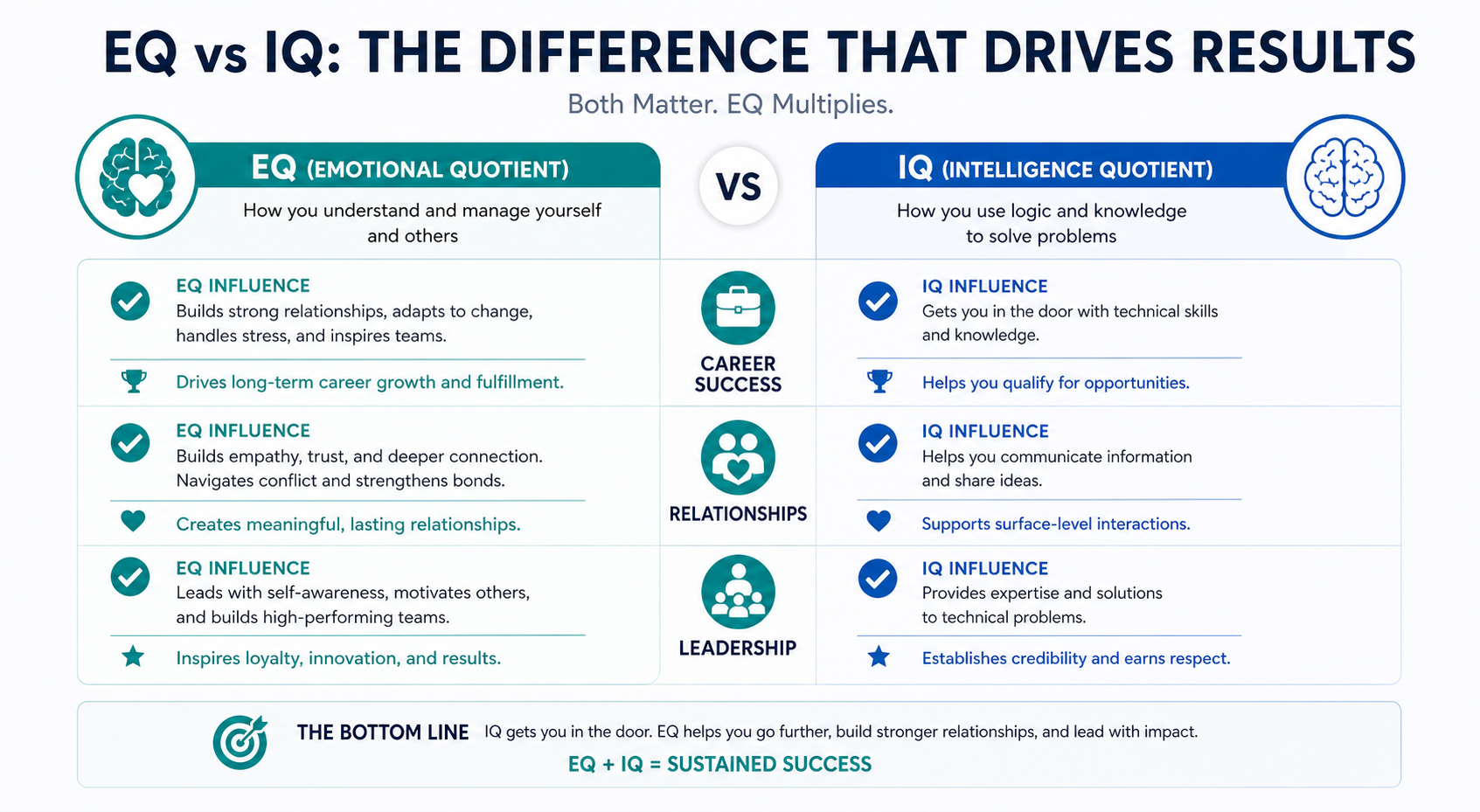
| Dimension | Emotional Quotient (EQ) | Intelligence Quotient (IQ) |
| % of Job Performance | Up to 58% | ~20% |
| Can Be Improved | Yes, at any age | Relatively stable |
| Leadership Correlation | Strongest predictor | Moderate predictor |
| Relationship Success | Primary driver | Minimal impact |
| Stress Management | Directly governs resilience | No direct connection |
| Income Impact | +$29,000/year average | Varies widely |
The data is clear: IQ gets you through the door, but EQ determines how far you go once inside. The most successful leaders, entrepreneurs, and high performers combine strong cognitive ability with exceptional emotional quotient skills and for those who want to develop both simultaneously, Biocybernaut’s research has demonstrated an average 11.7-point IQ increase alongside significant personality and emotional improvements from the same 7-day alpha training program.
How to Develop Your Emotional Quotient Skills
There are several proven approaches to building emotional quotient skills. Each operates at a different level behavioral, cognitive, or neurological and they can be used independently or in combination:
Mindfulness and meditation build self-awareness by training your attention to observe thoughts and emotions without reacting to them. Regular practice strengthens the prefrontal cortex, the brain region responsible for emotional regulation. However, meaningful progress typically requires months to years of consistent daily practice.
Journaling and self-reflection develop emotional vocabulary and pattern recognition. Writing about emotional experiences helps you identify triggers, understand recurring reactions, and track your growth over time. This method is accessible and free but relies entirely on self-report, which is limited by existing blind spots.
Coaching and therapy provide external feedback on your emotional patterns and help you develop new responses. Cognitive behavioral therapy (CBT) is particularly effective for self-regulation. Executive coaching can accelerate EQ development in professional contexts. Both require ongoing commitment and typically produce results over months to years.
Neurofeedback brain training operates at the neurological level the layer beneath thoughts, behaviors, and habits. By training the brain to produce more alpha waves and fewer excess beta waves, neurofeedback creates the neurological conditions in which all five EQ skills flourish naturally. This is not a behavioral technique or a cognitive reframe it is a structural change in how your brain functions.
The Biocybernaut advantage: While traditional EQ development methods work from the outside in (changing behavior to gradually influence the brain), neurofeedback works from the inside out retraining the brain directly so that emotional intelligence improvements emerge naturally. Biocybernaut’s 7-day Alpha One Training compresses months or years of EQ development into a single transformative week, with results that are scientifically shown to be permanent and to continue improving after training ends.
The Neuroscience of Emotional Quotient: Why Brainwaves Matter
Every emotional experience you have is preceded by a brainwave pattern. Before you feel anxious, your brain produces a specific electrical signature. Before you feel calm, creative, or empathetic, a different pattern emerges. Emotional quotient skills are not just psychological they are neurological.
The critical insight from four decades of Biocybernaut research is that people with high emotional quotient consistently produce more alpha brainwaves (8-13 Hz) and fewer excess beta waves (13-30 Hz) during emotional processing. Alpha waves are the signature of relaxed awareness, reflective thought, and emotional equilibrium. When your brain operates primarily in alpha, you naturally experience greater self-awareness, calmer emotional responses, increased empathy, and more effective social engagement.
Conversely, people with low EQ tend to be dominated by high-beta activity the brainwaves of stress, overthinking, reactivity, and emotional overwhelm. When your brain is stuck in beta, emotional intelligence becomes extremely difficult because the neurological environment simply does not support it. No amount of reading books or attending workshops can override a brain that is neurologically locked in fight-or-flight.
This is why neurofeedback is so powerful for EQ development. It does not teach you a technique or give you a framework to memorize. It changes the brainwave environment in which all emotional processing occurs. As Dr. James Hardt, founder of Biocybernaut Institute, explains: “Your personality is a function of your brainwaves. When you change your brainwaves, you change your personality.” Published research using the Minnesota Multiphasic Personality Inventory (MMPI) confirms this Biocybernaut trainees show measurable reductions in anxiety, depression, anger, and hostility, alongside increases in energy, friendliness, and clarity of thinking.
Signs of Low Emotional Quotient
Recognizing where your EQ needs development is the first step toward growth. Common signs of low emotional quotient include difficulty naming what you are feeling beyond basic labels like “fine” or “stressed,” frequent emotional reactions that feel disproportionate to the situation, a pattern of damaged or strained relationships, defensiveness when receiving criticism or feedback, blaming others or external circumstances for your emotional state, inability to read the emotional dynamics in a room, avoiding conflict entirely or escalating it beyond what the situation warrants, and persistent stress that feels unmanageable despite trying various coping strategies.
If you recognize several of these patterns, it does not mean something is wrong with you. It means your brain has been running patterns often established in childhood and reinforced over decades that limit your emotional capacity. These patterns can be changed. The question is how quickly and how permanently you want to change them.
Frequently Asked Questions About Emotional Quotient Skills
What are emotional quotient skills?
Emotional quotient skills are the abilities that allow you to recognize, understand, manage, and express your emotions while perceiving and responding to the emotions of others. The five core skills are self-awareness, self-regulation, motivation, empathy, and social skills. They can be learned and strengthened at any age.
Why is EQ more important than IQ?
Research shows EQ accounts for up to 58% of job performance and is the strongest predictor of leadership effectiveness. IQ accounts for roughly 20% of life success. High-EQ individuals earn an average of $29,000 more annually. EQ governs stress management, relationship quality, and decision-making areas IQ does not directly influence.
Can emotional quotient be improved?
Yes. Unlike IQ, EQ is highly trainable through mindfulness, journaling, coaching, therapy, and neurofeedback. Traditional methods produce results over months to years. Biocybernaut’s 7-day alpha training accelerates EQ development by retraining brainwave patterns directly at the neurological level.
How does neurofeedback improve emotional quotient?
Neurofeedback trains the brain to produce more alpha waves (calm awareness) and reduce excess beta waves (stress, reactivity). This neurological shift directly improves self-awareness, self-regulation, and empathy the foundational EQ skills. Biocybernaut’s 40 years of published research confirms measurable personality improvements and anxiety reduction from alpha training.
What are the 5 components of emotional quotient?
Daniel Goleman’s framework identifies five components: self-awareness (recognizing your emotions), self-regulation (managing reactions), motivation (internal drive), empathy (understanding others), and social skills (managing relationships). All five work as an interconnected system with self-awareness as the foundation.
How is emotional quotient measured?
EQ is assessed through validated instruments such as the Emotional Quotient Inventory (EQ-i 2.0), the Mayer-Salovey-Caruso Emotional Intelligence Test (MSCEIT), and the Trait Emotional Intelligence Questionnaire (TEIQue). These use self-report, 360-degree feedback, or performance-based tasks to evaluate emotional competencies.
What are signs of low emotional quotient?
Signs include difficulty identifying your emotions, frequent disproportionate reactions, strained relationships, defensiveness toward criticism, blaming others, low empathy, poor conflict resolution, and persistent unmanageable stress. These patterns are often rooted in brainwave imbalances that can be retrained.
How long does it take to improve EQ?
Traditional approaches (coaching, therapy, mindfulness) produce EQ improvements over months to years. Biocybernaut’s intensive 7-day program produces measurable personality and emotional regulation gains in a single week through direct brainwave retraining. Published research shows results continue improving after training ends. Call 855-784-0280 to learn more.
Ready to Build Emotional Quotient Skills at the Deepest Level?
Transform your EQ in 7 days through neurofeedback brain training backed by 40 years of science
Or call toll-free: 855-784-0280