
Flow State Training · Neuroscience · Peak Performance
Flow State Training: The Neuroscience of Peak Mental Performance
Elite athletes call it the zone. Neuroscientists call it transient hypofrontality. Here is exactly what happens in the brain during flow, and the most direct way to train it.
Dr. James V. Hardt, PhD and the Biocybernaut Research Team
Founder, Biocybernaut Institute · Creator of alpha training protocols used by athletes, executives, and elite performers · 40+ years of neurofeedback research · NIH and NIMH-funded · PubMed: 23341412
In This Article
- What Is Flow State? The Psychology and Science
- The Six Characteristics of Flow
- What Happens in the Brain During Flow
- Transient Hypofrontality: Why the Inner Critic Goes Quiet
- Flow State Brainwaves: Alpha, Theta, and Gamma
- The Neurochemical Cascade of Flow
- The Four-Stage Flow Cycle
- How Elite Athletes Use Alpha Bursts Before Peak Performance
- What Blocks Flow State
- How to Train Flow State With Alpha Neurofeedback
- The Research: Neurofeedback and Sports Performance
- Frequently Asked Questions
What Is Flow State? The Psychology and Science
You have experienced it. The two hours that felt like fifteen minutes. The code that practically wrote itself. The conversation in which exactly the right words arrived without searching. The musical performance in which your fingers moved faster than your conscious thoughts. The problem in front of you was not easy, but somehow every solution arrived precisely when you needed it.
That is flow state. And it is not mystical. It is a distinct, measurable neurological condition with specific electrical signatures, a predictable neurochemical profile, and specific triggers that can be learned, developed, and trained.
Psychologist Mihaly Csikszentmihalyi named it in the 1970s after conducting hundreds of interviews with athletes, chess grandmasters, surgeons, rock climbers, artists, and composers who described optimal performance states in remarkably consistent terms. The state of complete immersion in a challenging activity, where the sense of self dissolves, time distorts, performance peaks, and the activity carries its own intrinsic reward.
Csikszentmihalyi’s definition: flow is the state in which people are so involved in an activity that nothing else seems to matter. The experience itself is so enjoyable that people will do it even at great cost, for the sheer sake of doing it.
McKinsey Research
500%
productivity increase reported by top executives when working in flow states compared to their normal working state. This figure, from a McKinsey Global Institute research program, is the single most cited statistic in the peak performance literature. It explains why flow is no longer a philosophical curiosity but a serious performance objective for the world’s highest achievers.
The Six Characteristics of Flow
Csikszentmihalyi identified six core characteristics of flow that have been replicated across cultures, professions, and disciplines. Each has a measurable neural correlate that neuroscience has since mapped.
1. Intense Focus
Complete concentration on the present task. Attention is so fully engaged that external distractions cease to register. Neural correlate: suppression of the default mode network, the brain’s mental wandering system.
2. Action-Awareness Merger
The gap between doing and thinking about doing disappears. Action and awareness become one. Neural correlate: reduced prefrontal self-monitoring activity, allowing direct sensorimotor engagement.
3. Loss of Self-Consciousness
The inner critic, the social self-monitoring system, the part of the mind that worries about how it appears, temporarily goes offline. Neural correlate: transient hypofrontality in the dorsolateral prefrontal cortex.
4. Time Distortion
Time expands or contracts dramatically. Hours feel like minutes. Neural correlate: the prefrontal cortex, which tracks time, is deactivated, removing the subjective experience of duration.
5. Effortlessness
Actions feel fluid and automatic. Effort does not feel like effort. Neural correlate: alpha state optimization reduces the metabolic cost of cognitive processing, making complex performance neurologically cheaper.
6. Intrinsic Reward
The activity is its own reward. No external motivation is needed. Neural correlate: dopamine and endorphin release during flow creates intrinsic positive reinforcement that makes the activity deeply satisfying in itself.
What Happens in the Brain During Flow
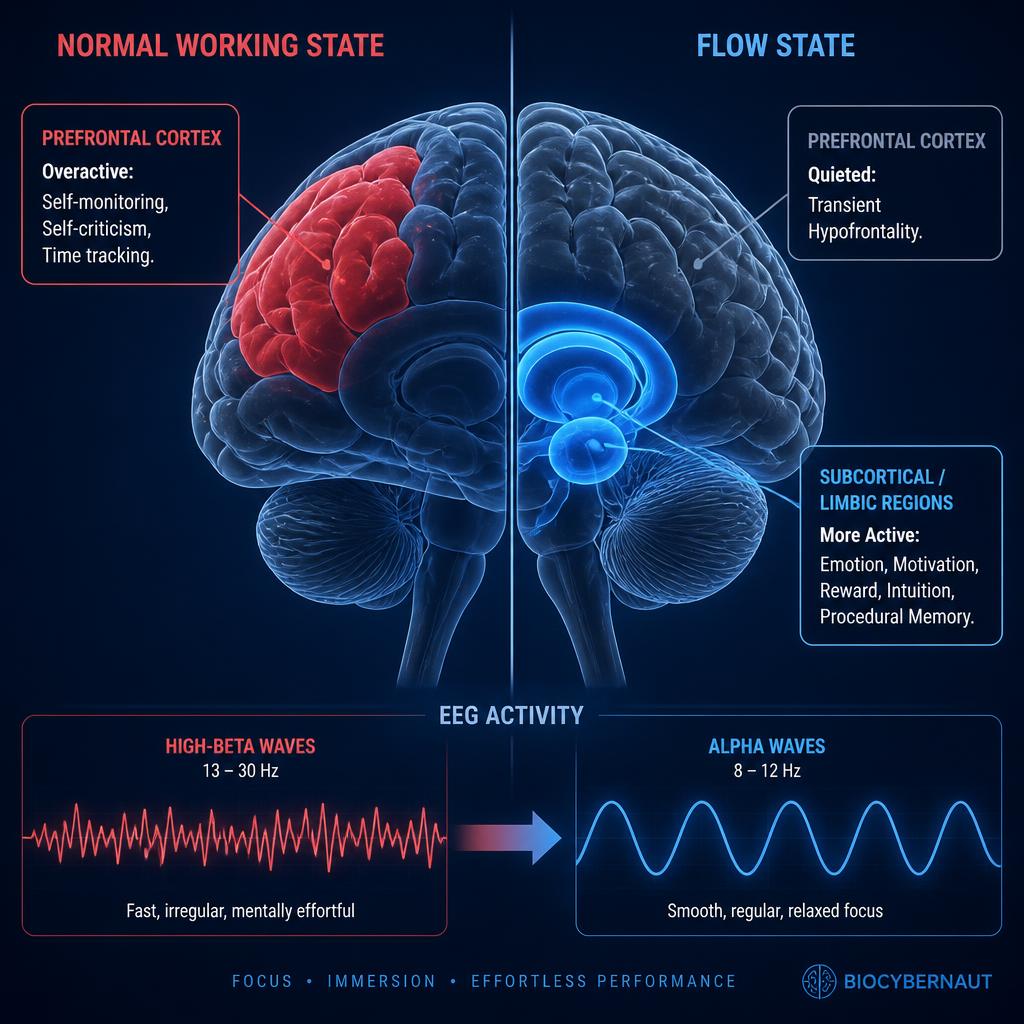
When someone enters flow, something counterintuitive happens: their brain becomes more efficient by doing less, not more. Several overlapping neurological processes occur simultaneously.
The prefrontal cortex, the brain’s most metabolically expensive region and the seat of conscious self-monitoring, deliberate decision-making, and self-critical evaluation, temporarily reduces its activity. This is not brain impairment. It is the opposite. The prefrontal cortex’s habitual activity includes a constant stream of second-guessing, self-evaluation, comparison with past performance, and monitoring of social impression. When it quiets, the brain’s faster, more automatic, more efficient processing systems take over.
In 2008, Johns Hopkins neuroscientist Dr. Charles Limb used fMRI scans to observe jazz musicians during improvisation. He found that the dorsolateral prefrontal cortex, the region responsible for self-monitoring and overthinking, became significantly less active during improvisation compared to playing a memorized piece. This quieting of the inner critic cleared the path for fast, intuitive, creative decisions. The musicians were not thinking about what to play. They were playing. The neural difference was measurable and unmistakable.
Simultaneously, subcortical limbic regions associated with reward, pattern recognition, and emotional engagement became more active. The brain was not shutting down; it was shifting from slow, effortful, conscious processing to fast, automatic, subconscious processing. This shift is the neural basis of flow’s most distinctive quality: the experience of effortless excellence.
Transient Hypofrontality: Why the Inner Critic Goes Quiet
Neuroscientist Arne Dietrich named the core neural mechanism of flow transient hypofrontality: temporary reduced activity in the prefrontal regions of the brain. Transient because it is temporary. Hypo because activity is reduced rather than eliminated. Frontality because the affected regions are at the front of the brain.
The prefrontal cortex houses what researchers call the executive function system: the capacities for planning, reasoning, impulse control, and critically, self-evaluation and self-monitoring. In ordinary waking consciousness, this system runs continuously. It tracks how you are performing relative to your expectations. It monitors how you appear to others. It calculates risk, anticipates failure, and generates the self-critical commentary that most performers experience as their inner critic.
During flow, this system goes quiet. When someone taps you on the shoulder during flow, they are not just breaking your concentration. They are forcing the prefrontal cortex to snap back online. Your inner critic, your time-tracking system, and your self-monitoring apparatus all reboot at once. This is why a 30-second interruption can cost 15 to 25 minutes of lost flow time. That is roughly how long it takes for the prefrontal cortex to power back down and for the flow-associated brainwave patterns to re-establish.
Understanding transient hypofrontality clarifies why certain experiences reliably produce flow and others reliably prevent it. Any activity that engages the prefrontal cortex’s self-monitoring function, including excessive performance anxiety, fear of judgment, perfectionism, or conscious technique analysis during performance, works directly against flow. Any training that reduces the chronic hyperactivation of the prefrontal cortex works directly toward it.
The Key Implication for Training
The single most important neural prerequisite for flow is a reduction in the chronic hyperactivation of the prefrontal cortex. Alpha brainwave training reduces high-beta overdrive and builds the calm, organized alpha baseline that allows transient hypofrontality to occur naturally and reliably rather than accidentally.
Flow State Brainwaves: Alpha, Theta, and Gamma
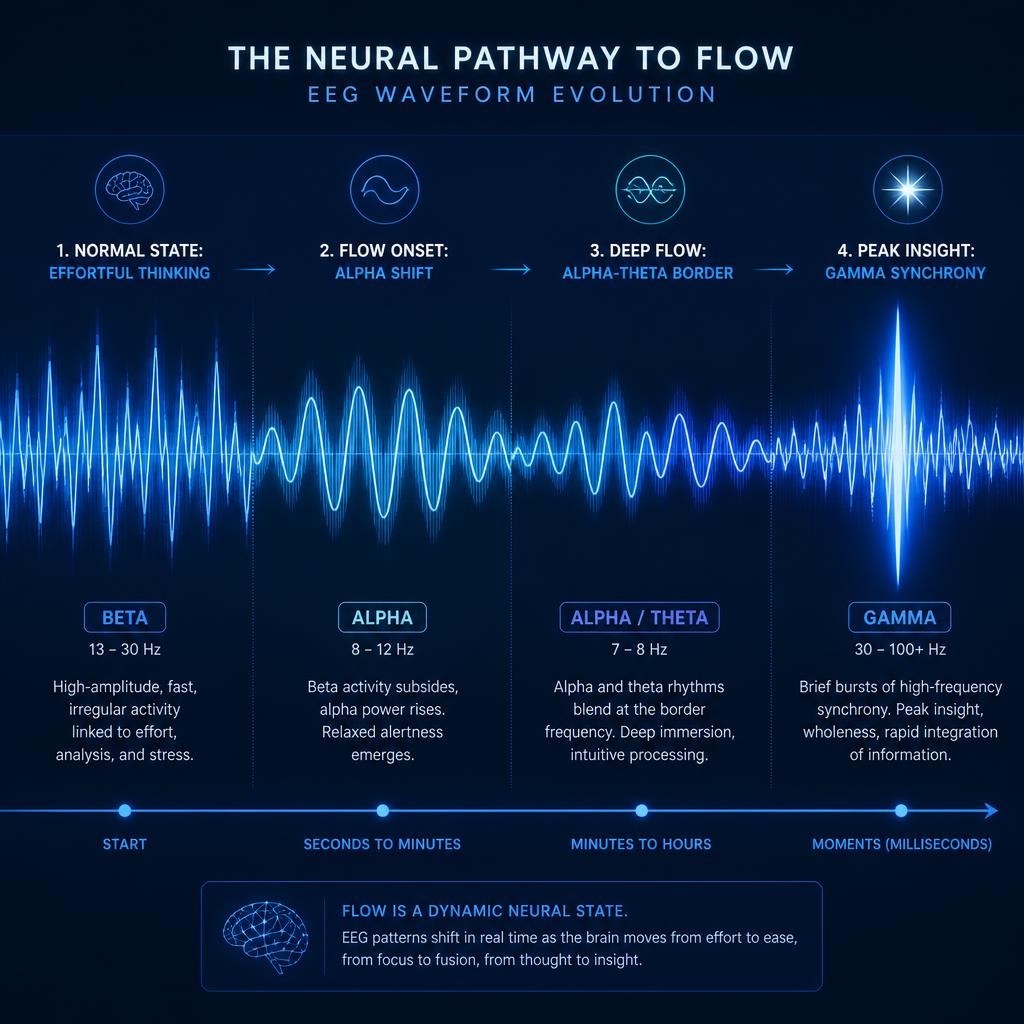
EEG research on flow state has revealed a consistent and distinctive brainwave signature that develops in stages as flow deepens.
The onset of flow begins with gamma. One of the first things to happen is a brief boost in gamma brainwaves, the fast synchronizing frequencies (30 to 100 Hz) that help different regions of the brain communicate with exceptional efficiency. Researchers describe this as switching from dial-up to fiber optic internet: information flows faster and connections between distant brain regions become clearer and more coordinated. This gamma synchrony primes the brain for taking on complex challenges.
As flow deepens, beta reduces and alpha rises. The fast, spikey, high-amplitude beta waves associated with effortful day-to-day thinking give way to the steady, smooth, organized alpha rhythm. The noise created by rapid, scattered neural firing quiets down. The brain creates what many describe as headspace, enabling fewer but more profound neural connections. This is the state of relaxed alertness, alert without effort, focused without strain.
At the deepest level of flow, the alpha-theta border. Flow states that produce feelings of selflessness, timelessness, effortlessness, and creative richness tend to show up at the low alpha and high theta brainwave states. The brain operates at the alpha-theta border, around 7 to 8 Hz, where the organized awareness of alpha and the subconscious creative access of theta combine. Creative breakthroughs, the kind of non-linear insight that distinguishes genius-level performance from competent performance, typically occur at this border.
The Neurochemical Cascade of Flow
Flow state is not just an electrical phenomenon. It is also a neurochemical one. When the brain enters flow, it releases a cascade of performance-enhancing neurochemicals that collectively create the distinctive felt quality of flow, including the sense of euphoric engagement, the unusual clarity of perception, and the deep intrinsic reward that makes flow-producing activities so compelling.
Dopamine
Released when we make progress and achieve pattern matches, dopamine drives motivation and locks attention onto the task. It is the neurochemical engine of focused engagement. High dopamine levels during flow are why the activity itself becomes magnetic, drawing attention forward without conscious effort.
Norepinephrine
Increases arousal, accelerates pattern recognition, and heightens sensitivity to relevant information while reducing sensitivity to irrelevant stimuli. Norepinephrine creates the heightened perceptual clarity that makes everything in the field of flow-relevant attention seem razor sharp.
Endorphins
Flood the brain during flow, dulling pain and creating euphoric engagement. This is why highly demanding physical or mental performance during flow does not feel like work. The endorphin system that normally activates in response to physical pain here activates in response to optimal performance challenge.
Anandamide
A naturally produced endocannabinoid, anandamide promotes lateral thinking, the ability to see non-obvious connections between disparate pieces of information. This is the neurochemical basis of creative flow’s characteristic feature: the sudden, surprising, perfectly right solution that emerges as if from nowhere.
Serotonin
Contributes to wellbeing and emotional stability during and after flow. Serotonin supports the afterglow, the lingering sense of satisfaction and rightness that follows a deep flow experience and signals the approaching completion of the flow state.
Why Recovery Matters
After flow, these neurochemical stores are depleted. The brain needs sleep, nutrition, sunlight, and low-stress activity to replenish them. Ignoring the recovery phase and chasing flow continuously leads to burnout. The Flow Cycle requires all four stages: struggle, release, flow, and recovery.
The Four-Stage Flow Cycle
Flow is not a switch you flip. It is a cycle you move through. Researcher Herb Benson at Harvard identified the cycle, and the Flow Research Collective has spent years mapping its neuroscience. Understanding the full cycle is essential for training flow reliably rather than encountering it accidentally.
Stage 1: Struggle
This is the loading phase. The brain absorbs information, wrestles with complexity, and burns through cortisol and norepinephrine. It feels bad. The frustration when you first sit down to tackle a hard problem, when the words will not come, when the code will not compile, that is not failure. That is the brain doing exactly what it needs to do to set up flow. Beta brainwaves are high. The inner critic is loud. The prefrontal cortex is working overtime. The critical mistake most people make: quitting during struggle and interpreting the discomfort as a signal that flow will not arrive today. Struggle is the prerequisite, not the obstacle.
Stage 2: Release
The transition between struggle and flow. The brain needs to step back from the problem after the struggle phase to allow the subconscious to process. This is why so many creative breakthroughs come in the shower, on a walk, or in that twilight moment just before sleep. The release phase requires a deliberate reduction in effortful conscious engagement. Activities that produce low-level engagement without mental demand, a walk, physical exercise, a brief rest, create the conditions for release. Beta drops. The brain begins to shift toward alpha.
Stage 3: Flow
The target state. Alpha rises, high-beta drops, transient hypofrontality occurs, and the neurochemical cascade activates. Time distorts. Self-consciousness disappears. Action and awareness merge. Performance peaks. The deeper the flow, the more alpha and theta combine at their border around 7 to 8 Hz. Gamma bursts punctuate peak insight moments. This state can last minutes to hours depending on the depth of the preceding struggle and release phases, available neurochemical reserves, and the strength of the individual’s alpha baseline.
Stage 4: Recovery
The neurochemicals consumed during flow must be replenished. After deep flow, the brain’s neurochemical stores are depleted, and a period of recovery is not optional. It is biological necessity. Rest, sleep, nutrition, and low-demand time are required to restore the neurochemical conditions that make the next flow state possible. High performers who skip recovery and force repeated flow states without rest deplete their neurochemical capacity and eventually lose the ability to access flow at all. The recovery phase is what makes flow sustainable.
How Elite Athletes Use Alpha Bursts Before Peak Performance
EEG research on elite athletes in precision sports has produced one of the most compelling findings in the flow state literature. In the seconds immediately before a peak performance shot, archery release, golf putt, or basketball free throw, elite athletes produce a characteristic burst of alpha waves in their left hemisphere frontal region, the region associated with verbal analytical processing.
Novice and intermediate athletes do not show this pattern. Their frontal left hemisphere remains active with beta waves right up to the moment of performance, reflecting ongoing analytical processing, technique monitoring, and self-evaluation. Elite performers, by contrast, quiet this region precisely when performance demands maximum efficiency from their motor systems. Their alpha burst is the neurological signature of the inner critic going offline just when it matters most.
This finding has significant implications for athletic training. The ability to produce a reliable pre-performance alpha burst is not just a correlation of elite performance: it is one of its neurological mechanisms. Athletes who train this capacity systematically develop the ability to quiet their analytical mind on demand, reducing the interference between conscious technique awareness and the automatic, expert motor execution that peak performance requires.
Research Finding: Golf Neurofeedback Meta-Analysis, Frontiers in Psychology, 2026
A 2026 meta-analysis published in Frontiers in Psychology examining EEG neurofeedback and golf putting performance found that elite golfers showed a moderate positive effect (SMD = 0.89) from neurofeedback training, likely because interventions refined already efficient cortical processes and optimized pre-movement SMR oscillations to reduce cognitive interference. The finding supports the direct link between alpha-state training and the pre-performance neural quieting that distinguishes elite from average athletic performance.
What Blocks Flow State
Understanding what prevents flow is as practically important as understanding how to produce it. Five neurological patterns consistently suppress flow across all domains of performance.
Chronic High-Beta Overdrive
The stressed brain locked in anxious high-beta activity cannot shift into alpha. The prefrontal cortex remains hyperactivated, preventing the transient hypofrontality that flow requires. Chronic stress is the single most powerful flow-suppressor in modern life.
Performance Anxiety
Fear of evaluation, perfectionism, and comparison with an idealized standard all hyperactivate the dorsolateral prefrontal cortex, exactly the region that must quiet for flow to emerge. Performance anxiety and flow are neurologically incompatible.
Low Alpha Baseline
A brain that rarely produces alpha in ordinary waking consciousness cannot smoothly shift into alpha-dominant flow states under performance pressure. The alpha state needs to be developed as a stable, readily accessible neural capacity, not an occasional accident.
Digital Overstimulation
Constant notifications, social media fragmentation, and continuous partial attention keep the brain in high-beta fragmentation. The neural conditions required for flow, consolidated attention and a quiet inner critic, are the precise opposites of what constant digital stimulation produces.
Inadequate Challenge-Skill Match
Csikszentmihalyi’s foundational insight: flow emerges at the edge of one’s ability. Too easy produces boredom. Too hard produces anxiety. Both states prevent flow. The challenge must be just above current skill level to produce the engagement that leads to flow.
Neurochemical Depletion
Attempting flow without adequate sleep, nutrition, or recovery depletes the neurochemical reserves that the flow state draws on. A brain running low on dopamine and norepinephrine precursors cannot generate the neurochemical cascade that flow requires.
How to Train Flow State With Alpha Neurofeedback
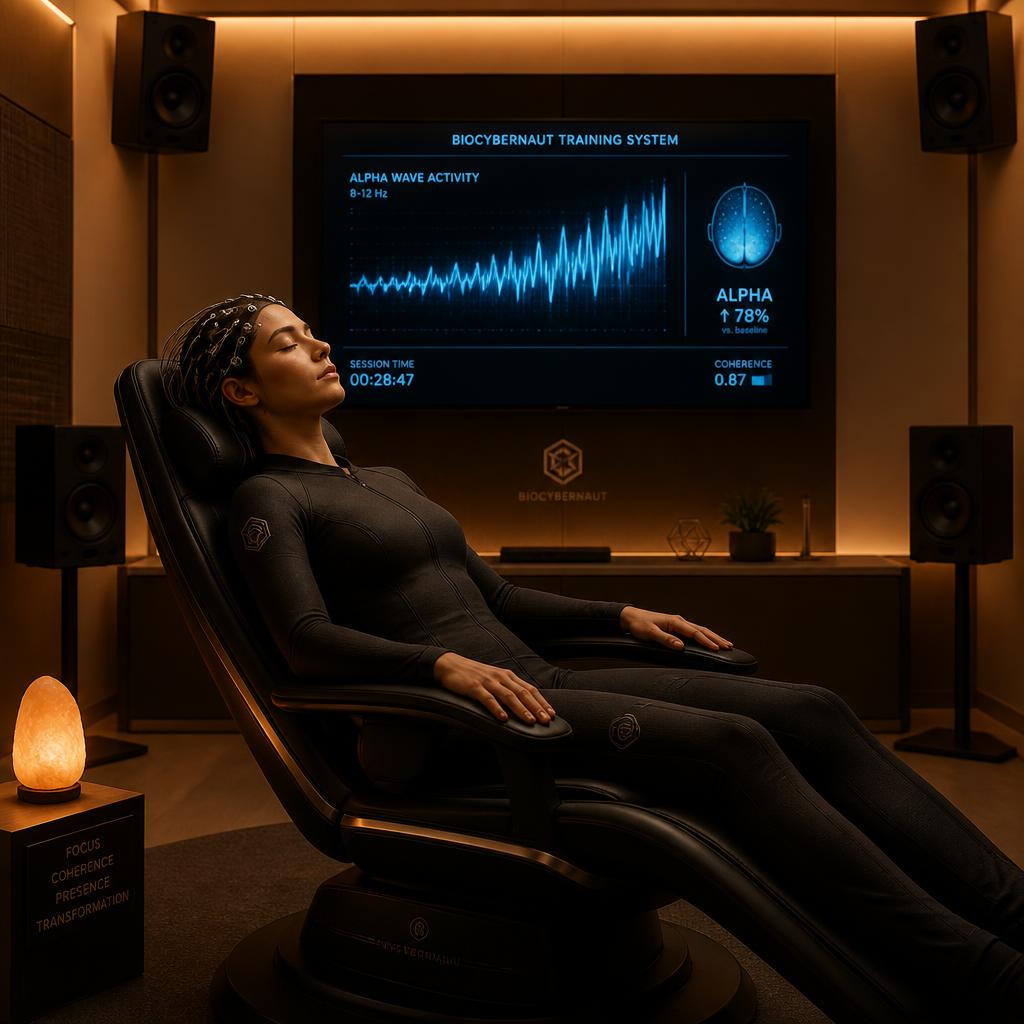
The most direct path to reliable, on-demand flow state access is building the neural foundation that makes it possible: a strong, stable, high-amplitude alpha baseline. When the brain’s resting alpha is consistently elevated, the shift into flow requires less trigger, less perfect challenge-skill matching, and less time in the struggle phase before release and flow occur.
Alpha brainwave neurofeedback training is the most precise, measurable method for building this alpha foundation. The training directly rewards the production of alpha amplitude at specific cortical sites, building the calm, organized, relaxed alertness that is both the on-ramp to flow and the neurological antidote to the chronic high-beta stress patterns that most commonly prevent it.
Biocybernaut’s intensive 7-day Alpha One program develops the alpha baseline comprehensively and rapidly. The intensive format matters for flow training specifically because it allows the new alpha capacity to consolidate across consecutive days of training, building a stable neural architecture rather than a temporary session-by-session state. Graduates report that activities which previously required significant effort to reach flow, athletic training, creative work, demanding professional tasks, begin producing flow more readily and more deeply after alpha training, and that the states last longer when they do occur.
The Research: Neurofeedback and Sports Performance
Scandinavian Journal of Medicine and Science in Sports, 2025
EEG Neurofeedback Training and Sports Performance: Systematic Review and Meta-Analysis
A comprehensive 2025 meta-analysis published in the Scandinavian Journal of Medicine and Science in Sports reviewed all available research on EEG neurofeedback training and sports motor performance. The authors noted that 8 high-quality studies were published in 2023 and 2024 alone, reflecting rapid growth in the field. The review incorporated the CRED-nf checklist for methodological evaluation and examined neurofeedback’s effects on cognitive, emotional, and motor outcomes across precision sports, endurance performance, and team sport contexts. The psychomotor efficiency hypothesis, which suggests that optimizing brain function enhances athletic ability, was supported across multiple study designs.
Frontiers in Psychology, 2024
Evaluating EEG Neurofeedback in Sport Psychology: RCT Review
A 2024 systematic review of randomized controlled trials published in Frontiers in Psychology confirmed that EEG neurofeedback training helps athletes control their mental states and improve performance using EEG through operant conditioning to alter brainwave patterns. Alpha-theta neurofeedback training specifically was found to increase cognitive creativity in dance performance research, while SMR training optimized pre-movement oscillations to reduce cognitive interference in precision athletes. The review confirmed the role of neurofeedback in developing the specific mental state control that underlies reliable flow access.
Scientific Reports, 2025
Intelligent Sport Training via EEG Neurofeedback: Shooting Performance and Cognitive Engagement
A 2025 Scientific Reports study examined EEG neurofeedback across a 4-week sports training program. Results showed that the experimental group significantly improved SMR regulation, reduced theta activity at rest, and better controlled high-beta oscillations associated with performance anxiety. Measures of shooting performance, simple and choice reaction times, and EEG markers were assessed before, after, and at 4-week follow-up, confirming durability of the neurofeedback-induced neural changes and their translation into measurable performance gains.
Biocybernaut Research, NIH-funded
Alpha Training, IQ, Creativity, and Peak Performance Outcomes, PubMed: 23341412
Biocybernaut’s 40-year research database, supported by the NIH and NIMH and published in Advances in Mind-Body Medicine, documents consistent peak performance outcomes from 7-day alpha training. Stanford Research Institute scientists who completed the program showed an average 50% increase in creativity scores. Average IQ gains of 11.7 points were recorded. These outcomes are the direct consequence of building a stronger alpha baseline, which in turn makes the neurological conditions for flow more readily accessible and more deeply entered.
“There is no problem that cannot be solved in Alpha. By the end of the week, all three of us were able to enter a state of Alpha. I recommend it to anyone who wants to grow immensely.”
Tony Robbins, after completing Biocybernaut Alpha One Training
Build the Neural Foundation of Flow
Train Your Alpha Baseline in 7 Intensive Days
Biocybernaut’s Alpha One program builds the strong, stable alpha baseline that makes flow states more accessible, deeper, and more consistent. One week. Measurable, lasting results. Sedona, AZ or Bavaria, Germany.
Sedona, Arizona · Bavaria, Germany · Limited spots available per program
Frequently Asked Questions
What brainwaves are active during flow state?
Flow states involve a characteristic and progressive brainwave shift. As flow begins, gamma bursts appear as different brain regions coordinate. As flow deepens, fast beta waves associated with effortful thinking reduce and alpha waves (8 to 12 Hz) rise, particularly in frontal regions. At the deepest level of flow, the brain operates at the alpha-theta border around 7 to 8 Hz, where the organized clarity of alpha and the subconscious creative access of theta combine. Brief gamma spikes punctuate peak insight moments throughout. This is the same brainwave profile that advanced meditators develop after decades of practice, and that Biocybernaut’s 7-day alpha training produces in novice trainees.
What is transient hypofrontality?
Transient hypofrontality, named by neuroscientist Arne Dietrich, is the temporary reduction in prefrontal cortex activity that occurs during flow states. The dorsolateral prefrontal cortex, responsible for self-monitoring, self-criticism, time tracking, and second-guessing, becomes significantly less active. When this inner critic powers down, action becomes faster and more intuitive, creativity flows freely, and the experience of effortless performance becomes possible. This is the neural mechanism behind losing yourself in what you are doing, and why a 30-second interruption can cost 15 to 25 minutes of lost flow time to re-establish.
Can you train yourself to access flow states?
Yes. Flow states are not random accidents. They are learnable, trainable brain states with specific neurological prerequisites. The most direct method is alpha brainwave neurofeedback training, which builds the calm, organized alertness of the alpha state that serves as the neurological on-ramp to flow. A 2025 meta-analysis in the Scandinavian Journal of Medicine and Science in Sports confirmed that EEG neurofeedback training significantly improves sports performance outcomes, with strong evidence accumulating particularly from 2023 and 2024 high-quality studies. Biocybernaut’s intensive 7-day format builds this alpha foundation comprehensively and rapidly.
What is the Flow Cycle and why does it matter?
The Flow Cycle, mapped by researcher Herb Benson and the Flow Research Collective, has four stages: struggle, release, flow, and recovery. During struggle, beta is high and the prefrontal cortex works hard. Release is the transition where effortful thinking relaxes and the subconscious begins processing. Flow is the target state where alpha and theta rise and performance peaks. Recovery is essential because the neurochemicals consumed during flow must be replenished before the next flow state becomes possible. Most flow failures happen in two places: quitting during struggle before release can occur, and skipping recovery until neurochemical depletion prevents flow entirely.
What neurochemicals are released during flow state?
During flow, the brain releases a cascade of five performance-enhancing neurochemicals. Dopamine drives motivation and locks attention onto the task. Norepinephrine increases arousal and pattern recognition. Endorphins reduce pain and create euphoric engagement. Anandamide, a naturally produced endocannabinoid, promotes lateral thinking and the creative connection-making that defines flow’s insight generation. Serotonin contributes to wellbeing and the afterglow following the flow experience. This neurochemical cascade is responsible for both the extraordinary performance quality and the deep intrinsic reward of flow states, which is why people willingly push through the preceding struggle phase to reach them.
Continue Reading
What Is Neurofeedback Training? The Complete Science Guide
Neurofeedback for Executives: How Top CEOs Use Brainwave Training
Brain Optimization: The Science-Backed Way to Upgrade Your Mental Performance
Alpha One vs. Alpha Two vs. Alpha Three: Program Comparison
Stress Reduction Training: Why Brainwave Therapy Outperforms Traditional Methods
About The Author
Dr. James V. Hardt, PhD, Founder, Biocybernaut Institute
Dr. Hardt’s four decades of research into alpha brainwave training have produced the most extensive clinical database on neurofeedback and peak performance outcomes in existence. His work demonstrates that building a strong, stable alpha baseline, the neurological foundation of flow state, produces simultaneous improvements across all dimensions of performance: IQ, creativity, emotional intelligence, stress resilience, and the speed and depth of flow state access. Stanford Research Institute scientists who completed the program showed an average 50% increase in creativity. US Army Green Berets showed meaningful improvements in mission-critical performance dimensions. He holds a B.S. in Physics from Carnegie Institute of Technology and a Ph.D. in Psychology from Carnegie-Mellon University, with post-doctoral training in Psychophysiology at UCSF.
Biocybernaut Institute · biocybernaut.com · Sedona, AZ and Bavaria, Germany · 855-784-0280
Medical Disclaimer: This article is for informational and educational purposes only and does not constitute medical advice, diagnosis, or treatment. Individual results from neurofeedback training vary. The performance and flow state outcomes cited reflect data from Biocybernaut’s 40+ year peer-reviewed research database and published scientific literature. The McKinsey productivity figure reflects corporate research findings. Consult a qualified healthcare provider before beginning any brain training or therapeutic program.