
Stress Reduction · Brainwave Training · Comparison Guide
Stress Reduction Training: Why Brainwave Therapy Outperforms Traditional Methods
Apps, CBT, mindfulness, medication, you’ve probably tried some of them. Here’s an honest comparison of every major stress reduction approach, and why only one addresses the neurological root of chronic stress.
Dr. James V. Hardt, PhD & the Biocybernaut Research Team
Founder, Biocybernaut Institute · 40+ years of neurofeedback research · NIMH-funded stress and anxiety studies some of those published in: Hardt, J.V. and Kamiya, J., Anxiety change through EEG alpha feedback: Seen only in high anxiety subjects. 2017, Vol. 201, pp. 79-81, 1978. Addition research showing broad effectiveness of Alpha training in reducing many types of Psychopathology was Published in Advances in Mind-Body Medicine (PubMed: 23341412) · Carnegie-Mellon PhD in Psychology & Psychophysiology
In This Article
- The Modern Stress Crisis: Why Everything You’re Doing Isn’t Enough
- The Neuroscience of Stress – Why It Starts in the Brain
- Traditional Stress Reduction Methods: What Works, What Doesn’t
- Why Brainwave Training Is Categorically Different
- The Research: What Clinical Studies Show
- Full Method Comparison: All Stress Reduction Approaches Side by Side
- How Biocybernaut Delivers Lasting Stress Relief in 7 Days
- Who Is Stress Reduction Training For?
- Frequently Asked Questions
The Modern Stress Crisis: Why Everything You’re Doing Isn’t Enough
Chronic stress has become the defining public health crisis of the modern era, and the tragedy is that most stress reduction approaches address it at exactly the wrong level.
In 2026, 66% of U.S. workers report burnout, up from previous years, despite an explosion in mindfulness apps, employee wellness programs, and stress management training. In the UK, 91% of adults reported high or extreme levels of pressure or stress in the past year. The data could not be clearer: awareness of the problem has never been higher. Effective results have never been more elusive.
$300B
lost annually by U.S. companies to job stress (American Institute of Stress)
66%
of U.S. workers report burnout in 2026 (NAMI-Ipsos)
120K
U.S. deaths annually linked to chronic occupational stress[2]
1M
Americans miss work every single day due to stress-related symptoms[3]
The wellness industry’s response to this crisis has been to offer more tools for managing the experience of stress. Meditation apps. Breathing exercises. Cognitive reframing. Time management training. These are all valuable at the behavioral level. But none of them reach the actual source of the problem, which is not a behavioral problem at all. It is a neurological one.
Chronic stress is ultimately a brain state. And until the brain’s electrical patterns are directly retrained, no behavioral intervention, however well-designed, can produce lasting neurological change. This is the fundamental gap that brainwave training fills.
The Neuroscience of Stress: Why It Starts in the Brain
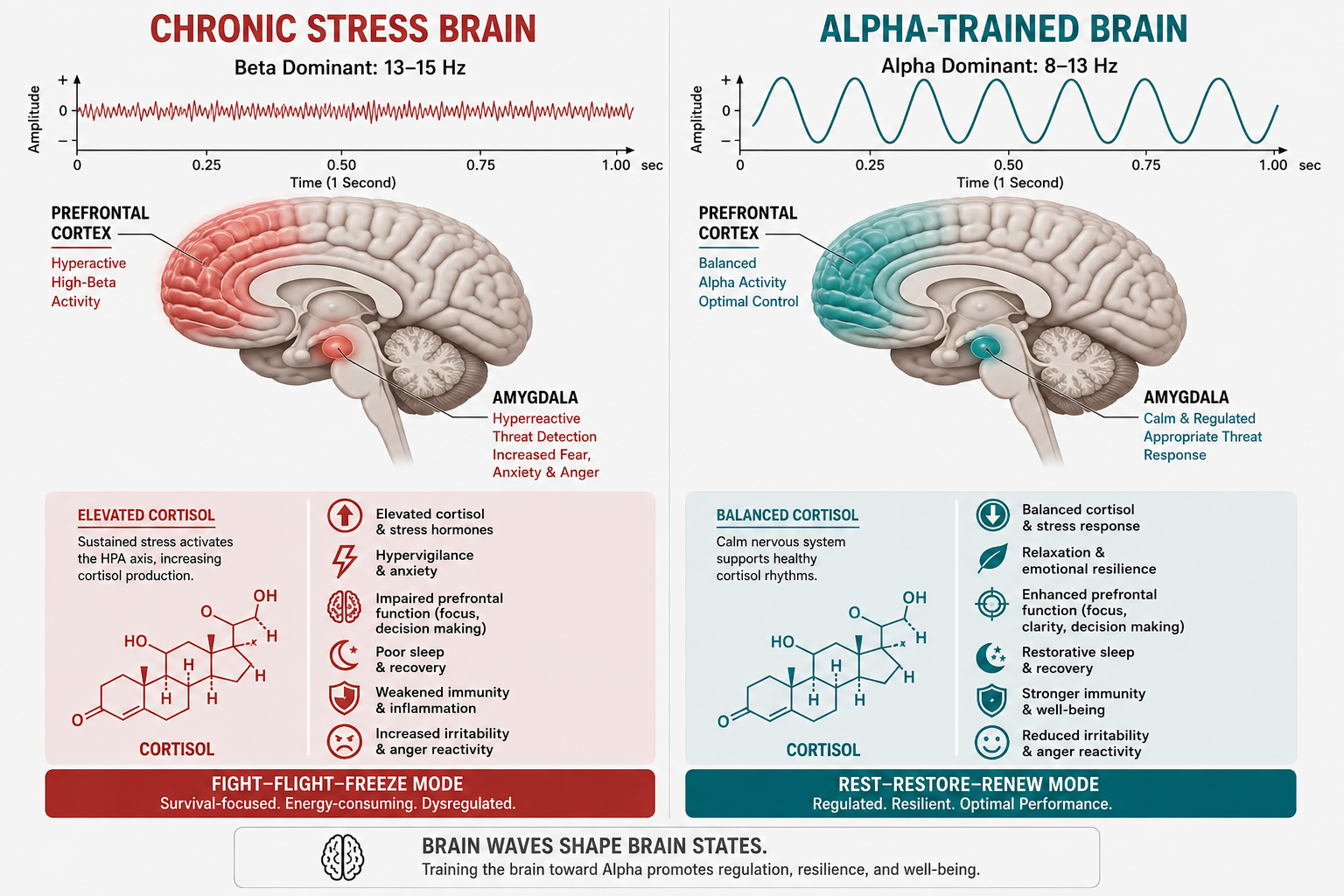
Stress is not simply a feeling. It is a measurable neurological state with a precise EEG signature. When the brain is under chronic stress, it gets locked into producing excessive fast-frequency beta waves, particularly high beta in the 13-25 Hz range. These patterns drive the sympathetic nervous system, suppress the prefrontal cortex’s ability to make calm, rational decisions, flood the body with cortisol and adrenaline, and create a self-reinforcing loop of threat perception.
Elevated cortisol over long periods impairs sleep, weakens immunity, disrupts mood regulation, and contributes to fatigue, burnout, and emotional exhaustion. Chronic stress increases cardiovascular risk by 40%, raises stroke risk in those working 55+ hours weekly by 35%, and has been linked to over 120,000 deaths per year in the United States.
The critical neurological detail: the brain’s natural antidote to stress, the Alpha state (8-13 Hz) is actively suppressed by chronic Beta overdrive. Research has consistently shown that anxiety and stress are inversely related to EEG Alpha activity. The more stressed the brain, the less Alpha it produces. The less Alpha it produces, the more stressed it becomes. This is the neurological trap of chronic stress.
The Key Neurological Insight
Chronic stress is a brainwave problem. Beta overdrive suppresses Alpha. Alpha suppression increases Beta and demonstrably increases anxiety and irritability (anger). The result is a self-reinforcing neurological loop that behavioral interventions can manage but cannot break because they operate at the level of thoughts and behaviors, not at the level of brain electrical patterns where the loop originates.
The Cortisol-Beta-Stress Cycle
Here is what happens physiologically during chronic stress: high-Beta brainwaves trigger activation of the hypothalamic-pituitary-adrenal (HPA) axis, releasing cortisol. Cortisol further sensitizes the amygdala’s threat detection, producing more high-Beta. The prefrontal cortex, which normally regulates this response, is suppressed by cortisol. Alpha production falls. The calming, regulatory state that would break the cycle becomes inaccessible.
This is precisely why people under chronic stress often say things like: “I know I should relax, but I just can’t switch off.” The brain’s own stress chemistry has removed its ability to access the neural state that would allow it to do so. No amount of knowing you should relax changes the underlying brainwave pattern until the pattern itself is directly trained.
Traditional Stress Reduction Methods: What Works, What Doesn’t
Let’s be honest about the most common stress reduction approaches. Each has genuine value and each has structural limitations that prevent it from solving chronic stress at the neurological level.
Cognitive Behavioral Therapy (CBT)
Strong Evidence
How it works: CBT identifies and restructures negative thought patterns that drive stress responses. It teaches behavioral strategies for managing stress triggers and improving emotional regulation through conscious cognitive work.
What research shows: MBSR and CBT have demonstrated comparable effectiveness for anxiety reduction, with 8-week programs showing meaningful symptom reduction. Strong evidence base across multiple conditions.
Strong evidence
8+ weeks required
Behavioral level only
Requires ongoing practice
Mindfulness-Based Stress Reduction (MBSR)
Good Evidence
How it works: MBSR is an 8-10 week program combining meditation, yoga, and body awareness to cultivate present-moment awareness and a non-reactive relationship with stressors.
Limitations: MBSR programs are 8 weeks long, involve group-based interventions, and require up to 45 minutes of daily home practice, all of which are potential barriers. They are also expensive and require consistent ongoing commitment to maintain results. Mindfulness cultivates awareness of the stressed state; it does not directly retrain the neural patterns producing it.
Holistic benefits
8-10 weeks minimum
Daily practice required
Results fade without practice
Meditation & Mindfulness Apps (Calm, Headspace, Muse)
Limited Evidence
How they work: Guided audio or visual meditations delivered via smartphone. Some (like Muse) incorporate basic EEG sensing to provide real-time feedback during sessions. Studies show meaningful short-term stress reduction with consistent use.
Critical limitation: These apps guide behavioral states they cannot measure whether the brain is actually producing different brainwave patterns. One study found only a 16% reduction in perceived stress after four weeks. When the app is not active, the brain returns to its default stressed patterns. The app is a crutch; it does not train the brain to be different without it.
Affordable
Weak evidence base
Requires constant use
No neural retraining
Exercise & Physical Activity
Strong Evidence
How it works: Physical exercise reduces cortisol, increases endorphins, and temporarily shifts brain activity toward calmer states. The benefits for stress and mood are well-documented and significant.
Critical limitation: Exercise-induced Alpha boosts are temporary typically lasting hours after a session.[1] Exercise builds physical resilience to stress but does not directly retrain the brain’s resting electrical baseline. A stressed person who exercises is still a stressed person between workouts.
Strong overall health benefits
Temporary brain effect
Doesn’t reset resting brain state
Anti-Anxiety Medications (SSRIs, Benzodiazepines)
Symptom Management Only
How they work: Medications alter brain chemistry to temporarily suppress stress responses. SSRIs take 4-8 weeks to show effects. Benzodiazepines provide fast relief lasting hours but carry dependency risk.
Critical limitation: No medication directly retrains the brain’s electrical patterns. They manage the neurochemical symptoms of chronic stress without addressing the underlying high-Beta brainwave patterns that generate it. When medication stops, the stress pattern resumes because nothing has changed at the neural electrical level.
Significant side effects
Dependency risk
No neurological retraining
Reverts when stopped
Why Brainwave Training Is Categorically Different
Every traditional stress reduction method operates at the surface level, managing thoughts, behaviors, chemistry, or physical tension. Brainwave training operates at the source level: the electrical activity of the brain itself, which generates the moods and the feelings.
This is not a matter of degree. It is a matter of mechanism. Managing stress through cognitive techniques is like adjusting the thermostat reading while the heating system runs at maximum. Brainwave training rewires the heating system itself.
Medical-grade EEG maps your unique stress pattern
Multi-channel EEG electrodes capture your brain’s electrical activity in real time, identifying exactly which frequency patterns are generating your stress response, your specific beta overdrive signature.
Real-time audio feedback teaches the brain to shift
Audio tones respond to your brainwave production instantly, adjusting their volume every 1/50-th of a second and you receive digital scores at the end of every 2-minute epoch. When Alpha increases, the tone rises. The brain receives immediate, precise feedback and begins to learn, through feedback, how to produce and sustain calmer frequencies.
The brain rewires its own default state
With repeated sessions over 7 intensive days, the brain’s resting baseline shifts. What was a default state of high-Beta stress becomes a new baseline of higher Alpha calm, organized, and resilient. This change is structural and neurologically encoded.
Results persist and grow for 12+ months without maintenance
Unlike every traditional method, brainwave training results are self-sustaining. The brain has learned a new way to operate and it continues using that new capacity independently. Research confirms benefits growing for 12+ months after the 7-day program ends.
The Research: What Clinical Studies Show
BIOCYBERNAUT PRIVATE PHILANTHROPIST FUNDED RESEARCH 2012
“Alpha Brain-Wave Neurofeedback Training Reduces Psychopathology,” Dr. Hardt
Advances in Mind-Body Medicine, 2012;26(2):8-12 · PubMed: 23341412
7 days of daily alpha neurofeedback produced a significant reduction of anxiety and stress-related psychopathology, with positive results across four standardized psychological measures. This was funded by the National Institute of Mental Health, confirming alpha brainwave training’s clinically meaningful impact on stress and anxiety at the neurological level.
Peer-Reviewed Evidence GAD & Stress, 2021
“Neurofeedback Training Improves Anxiety Trait and Depressive Symptom in GAD”
Brain and Behavior, 2021 · DOI: 10.1002/brb3.2024
A clinical trial of 26 patients with Generalized Anxiety Disorder showed that Alpha neurofeedback training improved anxiety, depression, and insomnia, three of the primary dimensions of chronic stress response. Results were measured using standardized clinical instruments, confirming that brainwave training produces objective, measurable change in stress-related outcomes.
Neurofeedback vs. Traditional Therapy Comparison – 2026
Neurofeedback Provides Faster Physiological Change Than Traditional Therapy
MYNeuroBalance Clinical Comparison Review, 2026
A comprehensive comparison of neurofeedback versus traditional therapeutic approaches found that neurofeedback therapy provides faster physiological changes than traditional therapy, while traditional therapy requires long-term commitment for behavioral transformation. Unlike medication, which shows effects in days to weeks but requires ongoing use, neurofeedback produces self-sustaining neurological change that does not require continued intervention to maintain.
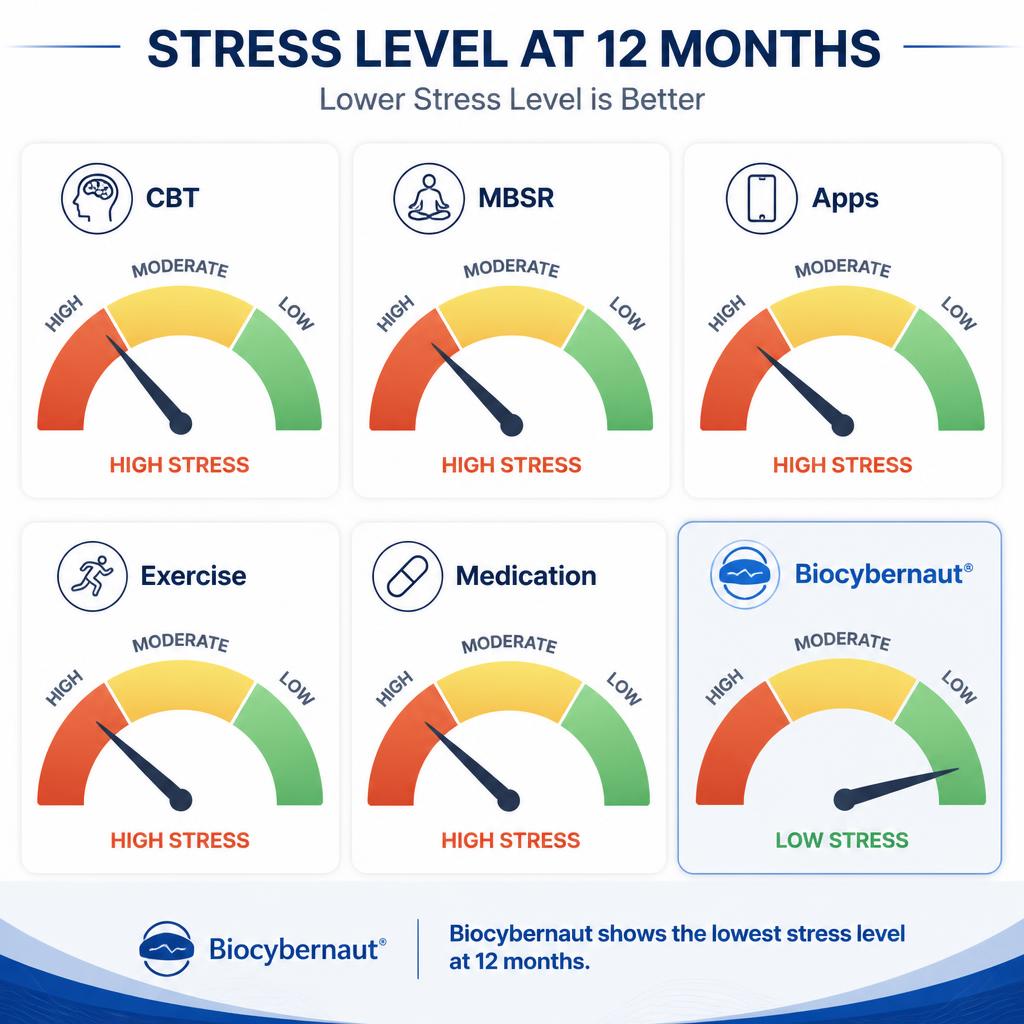
Full Method Comparison: All Stress Reduction Approaches Side by Side
How Biocybernaut Delivers Lasting Stress Relief in 7 Days
Biocybernaut’s approach to stress reduction combines the most scientifically precise neurofeedback technology available (Track 1 of the Biocybernaut training) with Dr. Hardt’s unique emotional intelligence framework (Track 2), addressing both the neurological and psychological dimensions of chronic stress simultaneously.
Measurable Cortisol Reduction
As Alpha rises through training, the HPA axis calms down. Cortisol and adrenaline production decrease measurably, not as a side effect, but as a direct neurological consequence of the trained brain state.
Emotional Intelligence Gains (+15.8 EQ points avg)
Emotional reactivity is a primary driver of workplace stress. Biocybernaut training improves EQ by an average of 15.8 points, creating greater emotional regulation, reduced interpersonal friction, and calmer responses to pressure.
Sleep Architecture Restored
Chronic stress disrupts sleep, and poor sleep amplifies stress. Alpha training normalizes the brain’s transition into restorative sleep states, breaking the stress-insomnia cycle that keeps so many high-performers chronically depleted.
Cognitive Clarity Under Pressure
The alpha state allows the prefrontal cortex to function without cortisol impairment. Graduates consistently report making better decisions, thinking more clearly under pressure, and recovering from stress events faster than before.
Forgiveness-Based Stress Release
Unresolved resentment and emotional holding patterns are primary drivers of chronic physiological stress. Biocybernaut’s patented forgiveness process, guided daily alongside the EEG training, removes these patterns at their emotional root.
7 Days. Results for 12+ Months.
One intensive week delivers what traditional stress management programs need months or years to approach, and the results continue growing. No ongoing sessions. No daily apps. No maintenance required.
“After Alpha Two training, I had this sense that my mind was operating more holistically, able to see many patterns at once. I’ve had the most productive five months in the history of my business, with none of the stress that used to accompany that level of output.”
Biocybernaut Graduate, CEO
Who Is Stress Reduction Training For?
Biocybernaut’s brainwave-based stress reduction training has proven effective across a remarkably wide range of stress profiles. What unites these individuals is not the type of stress they face it is the desire to address it at the level where it actually lives.
Executives & High-Pressure Professionals
Whose chronic stress is limiting decision quality, creativity, and resilience, and who need a solution that fits within a one-week executive schedule.
Athletes & High Performers
Whose performance anxiety and competition stress are creating a Beta-dominant brain state that locks out the Alpha flow states where their best performances live.
Those with Burnout & Chronic Exhaustion
Whose nervous systems have been running on cortisol for so long that rest no longer feels restorative and who need a neurological reset, not just a holiday or vacation.
Those Who’ve Tried Everything Else
Those who have done therapy, took medication, meditated, exercised, and still feel chronically stressed. Because until now, no one has addressed the electrical brain patterns at the source.
Trauma Survivors with Stress-Based Symptoms
Whose chronic stress is rooted in unresolved trauma held in the nervous system, where the forgiveness process and Alpha enhancement training reach what cognitive approaches cannot.
Personal Growth Seekers
Those who understand that a stressed brain is a limited brain and who see stress reduction not as symptom management but as the foundation for everything else they want to achieve: peak performance, sustained wellness, flourishing and higher consciousness.
End Chronic Stress at Its Neurological Source
Find the Right Biocybernaut Program for You
From Alpha One (the foundational 7-day stress reset) to our most advanced programs, Biocybernaut offers a complete pathway out of chronic stress and into lasting neurological calm. Let us help you find your starting point.
Sedona, Arizona | Bavaria, Germany | No medication. No side effects. Lasting results.
Frequently Asked Questions About Stress Reduction Training
What is the most effective stress reduction training?
Research and clinical evidence consistently show that brainwave neurofeedback training, particularly Alpha wave training, is the most structurally effective approach to chronic stress because it addresses the problem at its neurological root. Unlike behavioral approaches that teach coping strategies, neurofeedback trains the brain to stop producing the high-Beta patterns that generate stress in the first place. Biocybernaut’s intensive 7-day Alpha training program delivers this change more comprehensively than any other available approach, with benefits documented to continue growing for up to 2 1/2 years after the program ends.
Why do traditional stress reduction methods often fail long-term?
Traditional methods like CBT, mindfulness, and apps work at the behavioral and cognitive level they teach people how to manage stress responses and build coping skills. But they do not directly retrain the brain’s electrical activity, which is what produces the stress response chronically. When the behavioral practice stops or life becomes too busy for daily meditation, the brain reverts to its established high-beta patterns. Neurofeedback creates lasting neural change by training the brain directly, so results persist and grow rather than requiring constant maintenance.
How quickly does brainwave training reduce stress?
Most Biocybernaut participants notice the first meaningful reductions in stress, tension, and mental noise during Days 2-3 of the 7-day Alpha One program. The immersive intensive format creates a rapid neurological change that compressed weekly sessions over months cannot match. By Day 5-6, many graduates describe experiencing a baseline state of calm they have not felt in years. Post-training, benefits continue expanding for at least 2 1/2 years as the brain consolidates and builds on its new alpha-dominant baseline without any additional intervention.
Is there research supporting neurofeedback for stress reduction?
Yes, spanning over 40 years and including NIH-funded research. Biocybernaut’s research, published in Advances in Mind-Body Medicine (PubMed ID: 23341412) documented a significant reduction in anxiety and stress-related psychopathology following 7-day alpha training. Multiple independent peer-reviewed studies, including clinical trials published in Brain and Behavior and Frontiers in Neuroscience, confirm that alpha neurofeedback training significantly reduces cortisol, anxiety, and stress. The American Psychiatric Association has also recognized alpha-theta neurofeedback as a recommended intervention for stress-related conditions.
What makes Biocybernaut different from mindfulness apps for stress?
Mindfulness apps guide the brain toward calmer states through behavioral instruction, but they cannot measure whether the brain is actually producing calmer brainwave patterns or how much. They are passive tools. Biocybernaut uses a medical-grade multi-channel EEG to measure your brain’s alpha production in real time every three seconds, providing precise feedback that teaches the brain to produce calm states independently and permanently. One study found that consumer mindfulness apps produced a 16% reduction in perceived stress after four weeks. Biocybernaut graduates with the highest stress levels consistently normalize to below-average levels after 7 days, with results continuing to improve without any further intervention.
Ready to Stop Managing Stress and Start Eliminating It?
Compare Biocybernaut’s full program range and find the right starting point for your goals from the foundational Alpha One to our most advanced brain training experiences.
Continue Reading on Biocybernaut.com
About The Author
Dr. James V. Hardt, PhD, Founder, Biocybernaut Institute
Dr. Hardt has spent over five decades developing and validating the science of Alpha brainwave training as a solution to chronic stress, anxiety, and emotional dysregulation. His NIMH-funded research, his research funded for 12 years by the John Fetzer Foundation, his research funded by private philanthropists, has led to many important publications, like Science (1978) and Advances in Mind-Body Medicine (PubMed ID: 23341412). He has documented the most comprehensive brainwave training outcomes database in existence, dating from 1971, with continuous brain wave trainings ongoing since then. He holds a B.S. in Physics from Carnegie Institute of Technology, an M.S. and a Ph.D. in Psychology from Carnegie-Mellon University, with both pre-doctoral and post-doctoral training in Psychophysiology at UCSF. He has trained thousands of clients from Fortune 500 executives to US Army Green Berets, at a secret Army base and military veterans and trauma survivors in California and British Columbia training centers and ongoingly at Biocybernaut’s Sedona, Arizona, and Bavaria, Germany, centers.
Biocybernaut Institute | biocybernaut.com | Sedona, AZ & Bavaria, Germany | 855-784-0280
References
- Hogan, M. et al. (2022). Effects of exercise on electroencephalography-recorded neural oscillations: a systematic review. International Review of Sport and Exercise Psychology. Review of 37 studies confirmed that alpha activity increases during and immediately post-exercise are transient, returning to pre-exercise baseline within hours. Exercise does not produce durable shifts in the resting alpha baseline without sustained training intervention. doi:10.1080/1750984X.2022.2103841
- Goh, J., Pfeffer, J., & Zenios, S.A. (2016). The Relationship Between Workplace Stressors and Mortality and Health Costs in the United States. Management Science, 62(2), 608-628. See also: Goh, J., Pfeffer, J., & Zenios, S.A. (2015). Exposure to Harmful Workplace Practices Could Account for Inequality in Life Spans Across Different Demographic Groups. Health Affairs, 34(10), 1761-1768. doi:10.1377/hlthaff.2015.0022. Meta-analysis of 228 studies across 10 workplace stressors (Stanford University & Harvard Business School). Estimated approximately 120,000 excess deaths per year in the United States attributable to harmful workplace conditions. Cited by OSHA and the U.S. Surgeon General’s Framework for Workplace Mental Health (2022).
- American Institute of Stress. (2024). Workplace Stress. stress.org/workplace-stress. Approximately 1 million U.S. workers are absent from work every single day due to stress-related symptoms. Corroborated by OSHA Workplace Stress overview (osha.gov/workplace-stress) and peer-reviewed occupational health literature including Goh, Pfeffer & Zenios (2016).
Medical Disclaimer: This article is for informational and educational purposes only and does not constitute medical advice, diagnosis, or treatment. Neurofeedback training is not a substitute for professional medical care. If you are taking medication for stress or anxiety, do not discontinue it without consulting your prescribing physician. Results from Biocybernaut training vary between individuals. The outcomes cited reflect 40+ years of Biocybernaut’s research database and published peer-reviewed literature. Always consult a qualified healthcare provider before beginning any new therapeutic program.